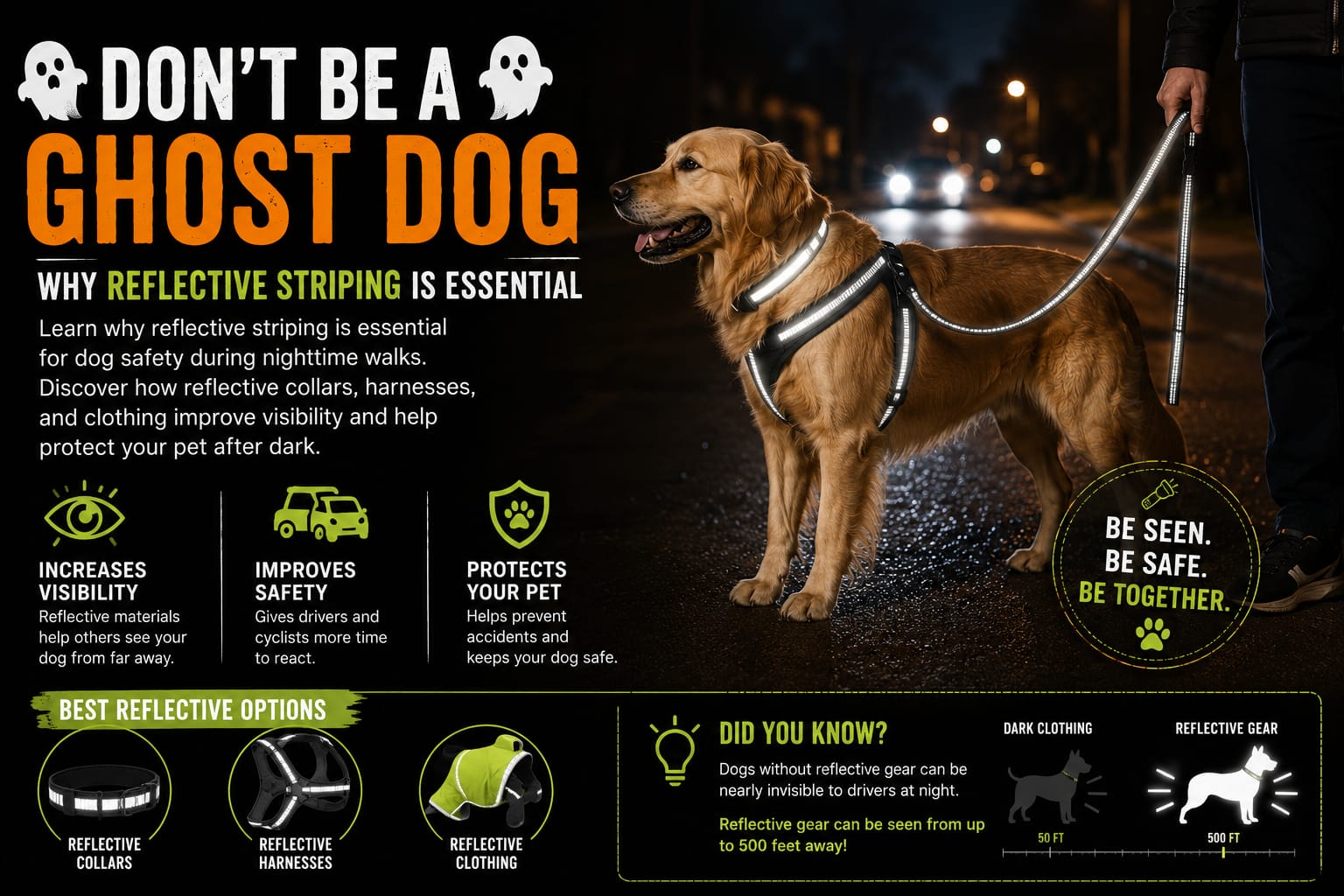
Don’t Be a Ghost Dog: Why Reflective Striping is Essential
Table of Contents
You’re walking down the sidewalk on a Tuesday evening in November. The sun dipped below the horizon an hour ago, and the streetlights are just starting to flicker on. Your dog is trotting happily a few feet ahead of you, sniffing a frost covered patch of grass. Suddenly, a car rounds the corner. The driver isn’t speeding, but the glare from oncoming headlights makes it hard for them to see the shadows. To that driver, your dark coated dog is basically invisible. You see the car, but the driver doesn’t see your pet. This is the “Ghost Dog” phenomenon, and it’s a terrifying reality for thousands of pet owners every winter.
Winter dog walk safety becomes a major concern the moment the clocks turn back. When the days get shorter, we’re forced into a routine of walking in the twilight or total darkness. It doesn’t matter if you live in a bright city or a quiet rural neighborhood. Visibility is the single most important factor in keeping your furry friend safe. If a driver can’t see your dog until they are ten feet away, it’s often too late to react. That is where reflective striping pet gear comes into play. It provides that split second of recognition that allows a driver to slow down and give you space.
How reflection actually works when you are out on the sidewalk
Most people think reflection is just a shiny surface, but there is actually some pretty cool science behind it. Traditional materials simply bounce light off in different directions. Retroreflective technology, which is what we use in high quality visible collars, is different. It’s designed to send the light back directly toward the source. If a car’s headlights hit a reflective strip, that light bounces straight back to the driver’s eyes. This makes the material appear to glow intensely even in low light conditions.
I learned this the hard way a few years ago. I used to think that because my dog was white, he was easy to see. One night, a neighbor mentioned they almost clipped us because they couldn’t distinguish his white fur from the dirty snow piles on the curb. That was a wake up call. Light colored fur isn’t enough. You need something that catches artificial light and throws it back at the person behind the wheel. When you use gear with reflective striping, you are essentially turning your dog into a moving beacon without needing batteries or bulky lights.
The beauty of this technology is its reliability. While LED lights are great, they can run out of juice or break if your dog decides to roll in a frozen puddle. Reflective strips don’t have a battery life. They are always “on” as long as there is a light source nearby. Whether it’s a car headlight, a neighbor’s porch light, or even a cyclist’s headlamp, your dog will stand out against the dark background.
Preparation is everything for a cold night out
Let’s be real, nobody enjoys being caught in a freezing rainstorm or a biting wind without the right equipment. Your dog feels the same way. Winter dog walk safety is about more than just being seen. It’s about being prepared for the elements. Before you even step out the door, you should have a routine. Checking the weather is step one, but checking your gear is a close second.
One thing I’ve noticed is that people often forget how quickly temperatures drop once the sun is gone. A walk that feels fine at 4 PM can feel like an arctic expedition by 5 PM. This affects your dog’s behavior too. They might be more prone to pulling or darting if they get a chill or if they see a shadowy figure they can’t quite identify. Having a secure, visible collar ensures that even if they do get a bit jumpy, they remain under your control and visible to everyone else on the road.
The ultimate winter walk safety checklist
- Check the integrity of the leash and collar for cracks caused by freezing temperatures.
- Ensure the reflective striping is clean and not covered by mud or thick fur.
- Carry a small flashlight to help you see patches of black ice on the sidewalk.
- Keep your phone charged in case you need to call for a ride if it gets too cold.
- Monitor your dog’s paws for salt or ice buildup which can cause discomfort.
- Wear reflective gear yourself so you are just as visible as your pet.
If you’ve ever tried this without a plan, you know how stressful it can be. You’re fumbling with gloves, trying to hold a leash, and squinting to see where your dog is going. Having the right gear simplifies the process. You can focus on the walk and the bond with your pet rather than constantly worrying about the car approaching from behind.
Why visible collars are the foundation of pet safety
When we talk about reflective striping pet gear, the collar is the most important piece. Why? Because it stays put. Sweaters can ride up, and harnesses can sometimes be obscured by the dog’s coat or a winter coat you’ve put over them. The collar sits high on the neck, which is often the most visible part of a dog’s silhouette. It’s the “central hub” for their identification tags and their connection to you.
You might be surprised to learn that not all reflective collars are created equal. Some use a cheap spray on coating that flakes off after a few weeks of wear. Others use a thin ribbon that loses its “glow” the moment it gets wet. Real safety gear uses woven reflective fibers or high grade heat pressed strips that are integrated into the fabric. This ensures the visibility lasts through snow, rain, and mud. When you are looking for a visible collar, you want to see that the reflective material is a significant part of the design, not just an afterthought.
Here’s the thing: visibility is only half the battle. If a collar is visible but uncomfortable, your dog is going to be miserable. Or worse, if it’s too thin, it can cause strain on their neck if they pull against the leash. That’s why padding is such a huge factor. A soft, padded interior prevents the edges of the collar from rubbing against the skin, which is especially important in winter when the air is dry and skin is more prone to irritation.
The science of distance and reaction time
To understand why this matters, we have to look at how drivers react. At 30 miles per hour, a car travels about 44 feet every second. If a driver sees a dog 100 feet away, they have about two seconds to react. If they don’t see the dog until they are 30 feet away, they have less than a second. Reflective striping can increase the distance at which a dog is visible by up to five times compared to standard nylon gear.
| Gear Type | Visibility Distance (Approx) | Driver Reaction Time | Safety Rating |
|---|---|---|---|
| Black Nylon Collar | 15 – 25 feet | Less than 1 second | Poor |
| Bright Neon (Non-Reflective) | 40 – 60 feet | 1 – 1.5 seconds | Fair |
| LED Battery Collar | 150 – 300 feet | 3 – 5 seconds | Good |
| High-Grade Reflective Striping | 200 – 500 feet | 4 – 8 seconds | Excellent |
As you can see from the table above, reflective striping pet gear provides a massive window for safety. It gives the driver enough time to see the “flicker” of light, realize there is a living creature there, and move over or slow down. Most accidents happen because the driver simply didn’t have enough time to process what was in front of them. By increasing that distance, you are giving your dog a protective shield made of light.
Spotlight: The Anti-Strangulation Reflective Dog Collar
If you are looking for a solution that hits all the safety marks, the anti-strangulation reflective padded collar is a standout choice. It addresses the two biggest fears every dog owner has: being hit by a car and getting choked by a collar. This specific piece of gear is designed for the active pet who needs to stay safe in unpredictable environments.
Most people buy this collar because it combines high-visibility reflective striping with a unique safety mechanism. The anti-strangulation feature is vital for dogs that might get caught on a fence or a branch during a walk. It allows for a bit of “give” or a quick release if the pressure becomes dangerous, preventing the tragic accidents that can happen with traditional “choke” style collars. It’s the perfect balance of security and safety.
In real life, this collar is a lifesaver for city dwellers who have to navigate busy intersections. The soft padding means that even if your dog lunges after a squirrel, the force is distributed across their neck rather than digging into their windpipe. I often recommend this for older dogs with sensitive necks or younger, high energy pups who haven’t quite mastered their leash manners. It looks sleek, it’s incredibly durable, and the reflective striping is integrated directly into the weave so it won’t wear down over time.
You can find this and other durable pet supplies and accessories in our shop. When you’re choosing a color, think about your dog’s coat. A bright blue or red looks great on almost any breed, but the reflective silver striping is the part that does the heavy lifting when the sun goes down.
Common mistakes people make with night walks
Even with the best intentions, it’s easy to make mistakes that compromise your safety. One of the biggest errors is relying on streetlights. Just because you can see the ground doesn’t mean a driver can see you. Streetlights create “pools” of light and deep shadows in between. If your dog is in a shadow when a car passes, they are invisible. You need gear that works independently of the environment.
Another mistake is using a retractable leash in the dark. These are dangerous enough in the daytime, but at night, the thin cord is completely invisible. A driver might see you on the sidewalk and think the path is clear, not realizing your dog is ten feet ahead of you on a thin wire. Stick to a standard 6 foot leash with reflective elements so the entire “unit” of you and your dog is visible to others.
Finally, don’t assume that because you are in a quiet neighborhood, you don’t need gear. In fact, quiet neighborhoods can be more dangerous because drivers are less alert. They don’t expect to see anyone walking, so they might be looking at their phone or adjusting the radio. You have to be the one to grab their attention. Using reflective striping pet gear is like waving a flag that says, “Hey, we are right here!”
Three quick tips for maximum visibility
- Layer your visibility: Use a reflective collar, a reflective leash, and maybe even a small light on your own jacket.
- Keep the gear clean: Dirt and salt can dull the reflective properties of the fabric. Wipe it down with a damp cloth once a week.
- Check the fit: A collar that is too loose will hang low and might be hidden by your dog’s chest fur. Ensure a snug but comfortable fit.
Honestly, the best way to stay safe is to assume you are invisible. If you walk with the mindset that every car is unaware of your presence, you’ll naturally take more precautions. Using the right gear just makes that job a whole lot easier.
The role of comfort in safety gear
We’ve talked a lot about the “reflective” part, but let’s talk about the “padded” part. In the middle of winter, the air is incredibly dry. Nylon webbing can become stiff and abrasive when it’s cold. If your dog has a short coat or sensitive skin, a standard collar can cause “collar sores” or hair loss. This isn’t just a comfort issue; it’s a safety issue. If a dog is uncomfortable, they are more likely to be distracted, agitated, and harder to control.
A padded collar provides a buffer. It uses materials like neoprene or soft mesh to create a cushion. This is especially helpful during winter dog walk safety routines because you might be walking in heavier gear yourself, and your movements might be a bit more jerky than usual. The padding absorbs the shock of any sudden pulls. It also helps to keep the neck area a little warmer, which your dog will definitely appreciate when the wind starts to howl.
When you look at the entire collection of home and pet goods available today, you’ll see that the trend is moving toward this “dual purpose” gear. We no longer have to choose between a collar that is strong and a collar that is comfortable. The modern designs incorporate high tensile strength nylon with soft interior linings, all wrapped in reflective striping pet gear technology.
Real world scenario: The “Near Miss” that changed everything
I want to share a story from a friend of mine, Sarah. She has a beautiful black Labrador named Shadow. As the name suggests, Shadow is hard to see at night. Sarah used to walk him with a standard leather collar. One evening, they were crossing a residential street. A car was backing out of a driveway. The driver looked in their rearview mirror, but because Shadow blended perfectly into the asphalt and the dark night, the driver started to accelerate.
Luckily, Sarah was wearing a bright white jacket and she was able to pull Shadow back just in time. But it was a heart stopping moment. The very next day, she bought a visible collar with heavy reflective striping. A week later, the same situation happened with a different neighbor. This time, as soon as the car’s reverse lights hit Shadow’s collar, the driver saw the bright silver reflection and slammed on the brakes immediately. The driver actually rolled down the window and said, “I’m so glad he was wearing that, I wouldn’t have seen him otherwise.”
That is the difference. It’s not just about avoiding a catastrophe; it’s about giving other people the chance to do the right thing. Most drivers are good people who don’t want to hurt anyone. By using reflective striping pet gear, you are helping them see the world more clearly.
Comparing different types of reflective gear
If you’re wondering which type of gear is best for your specific situation, it helps to compare the options. Not every walk requires the same level of equipment. A quick trip to the backyard is different from a three mile hike through a wooded trail.
For city walks, the main threat is cars. You want high intensity reflective strips that catch headlights from multiple angles. For trail walks, the threat might be losing your dog in the brush if they get off leash. In that case, a combination of reflective gear and a small battery operated light is best. The reflective striping helps you find them with your own flashlight, while the LED provides a constant point of light.
Let’s look at a quick comparison of the pros and cons of different safety setups:
Option 1: Only Reflective Collars
Pros: No batteries needed, very affordable, extremely durable, works 24/7. Cons: Only works when light hits it, might be obscured by very long fur.
Option 2: LED Light-Up Collars
Pros: Visible even without external light sources, very bright. Cons: Batteries can die, electronics can fail in wet weather, can be distracting for some dogs.
Option 3: Reflective Vests or Jackets
Pros: Huge surface area for reflection, adds warmth. Cons: Some dogs hate wearing clothes, can be too hot for some breeds, harder to put on and take off.
The sweet spot for most owners is a high quality padded collar with integrated reflection. It’s the most “set it and forget it” solution. You put it on, and you know your dog is protected every time they leave the house, regardless of whether you remembered to charge a battery or grab a vest.
Choosing the right size for safety and comfort
A safety collar only works if it stays on. One of the biggest mistakes I see is people buying a collar that is too big, thinking it will be more comfortable. If a dog can slip their head out of the collar, all that reflective striping won’t do you any good if they’re running across a busy road toward a squirrel.
To get the right fit, you should be able to fit two fingers comfortably between the collar and your dog’s neck. This ensures it’s tight enough that it won’t slide over their ears but loose enough that it doesn’t restrict their breathing or cause chafing. When you are buying online, always measure your dog’s neck with a soft tape measure rather than guessing based on their weight. Breeds have vastly different neck shapes, a Greyhound and a Bulldog might weigh the same but have completely different collar needs.
If you have a dog with a lot of “fluff” around the neck, like a Golden Retriever or a Husky, consider a slightly wider collar. The extra width helps the reflective striping stay visible above the fur. A thin 1/2 inch collar will disappear into a thick coat, while a 1 inch or 1.5 inch collar will sit on top and remain visible to passing cars.
Conclusion
Walking your dog should be the highlight of your day, not a source of constant anxiety. While the darker months of winter bring unique challenges, they don’t have to be dangerous. The simple addition of reflective striping pet gear can change the entire dynamic of your evening stroll. It moves your dog from being a “ghost” in the shadows to being a visible, recognized member of the community. It provides peace of mind for you and safety for them.
We often spend a lot of money on fancy treats and expensive toys, but a high quality visible collar is perhaps the best investment you can make in your dog’s long term well being. It’s a small price to pay for the security of knowing that drivers can see your pet from hundreds of feet away. Whether you choose a padded option for comfort or an anti-strangulation model for extra security, the goal is the same: making sure you both get back home safely.
Don’t wait for a “near miss” to realize your dog is hard to see. Take a look at your current gear tonight. If you stand in a dark room and shine a flashlight at it, does it glow? If not, it’s time for an upgrade. Your dog relies on you to be their advocate and their protector. By choosing the right gear, you are doing exactly that. Here is to many more safe, bright, and happy walks through the winter wonderland.
Frequently Asked Questions
How often should I replace my reflective dog collar?
The lifespan of a reflective collar depends on how often it’s used and the environment your dog lives in. Generally, a high quality collar can last two to three years. However, you should inspect it regularly for signs of wear. If you notice the reflective striping is starting to crack, peel, or fade, it’s time for a replacement. Exposure to heavy UV rays in the summer or extreme salt and ice in the winter can accelerate the breakdown of materials. For maximum winter dog walk safety, I recommend testing the reflectivity once a month by shining a light on it in a dark room to ensure it still pops.
Can I wash reflective striping pet gear in a washing machine?
Most nylon and padded collars are machine washable, but you should always check the manufacturer’s instructions first. To protect the reflective striping, it’s best to place the collar in a mesh laundry bag and use a gentle cycle with cold water. Avoid using harsh bleaches or fabric softeners, as these chemicals can dull the reflective surface over time. Air drying is always better than using a dryer. High heat can cause the adhesive on some reflective strips to fail or cause the nylon to become brittle. Keeping the collar clean is actually vital for safety because mud and grime can hide the reflective elements.
Is reflective gear better than LED light-up collars?
Both have their merits, but they serve different purposes. LED collars are great because they provide their own light source, making them visible even in total darkness where no other lights are present. However, they rely on batteries and can fail. Reflective striping pet gear is more reliable because it never runs out of power and is usually more durable for daily wear. Many experts suggest using a high quality reflective collar as your primary gear and adding a small clip-on LED light for extra visibility if you are walking in areas with absolutely no streetlights or traffic.
Does the color of the collar matter if it has reflective strips?
The base color of the collar matters more for daytime visibility than nighttime visibility. During the day, neon colors like orange, yellow, and green stand out best against natural backgrounds. At night, the color of the nylon becomes almost irrelevant, and the reflective striping takes over. The silver or white reflective material is designed to bounce light back most efficiently. So, while you can pick a color that matches your dog’s personality, make sure the visible collars you choose have a wide, high-contrast reflective strip that will do the work once the sun goes down.
My dog has very long fur, will a reflective collar still work?
Long fur can definitely be a challenge for visibility. If your dog has a thick mane, a thin collar will simply get buried. To combat this, look for wider collars or those specifically designed with “high loft” padding that helps the collar sit further out from the neck. You might also consider attaching a reflective charm or a longer reflective lead to the collar. Some owners also find that reflective harnesses work better for long-haired breeds because they cover more surface area on the back and sides, where the fur might be slightly shorter or more manageable.
Are padded collars too hot for dogs in the summer?
Most modern padded collars use breathable materials like neoprene or air-mesh. Neoprene is the same material used in wetsuits, and it’s actually quite good at staying comfortable across a range of temperatures. It doesn’t trap heat as much as you might think. While a padded collar is slightly thicker than a single-ply nylon strap, the comfort benefits usually outweigh any heat concerns. If you live in an extremely hot climate, look for the mesh-lined versions which allow for maximum airflow while still providing that necessary cushion for your dog’s neck during walks.
Latest Posts 🔥




Visit Store

Unlock Exclusive Offers!
Unlock Exclusive Pet & Home Spooky Deals Limited-Time Access!
Your Information Will Not Be Shared With Anyone.